Documentation Index Fetch the complete documentation index at: https://docs.tela.com/llms.txt
Use this file to discover all available pages before exploring further.
Within your Workstation App you can create tasks and review their output to check if the answers are correct.
Creating tasks via API
Creating a new task is similar to making a call to your Canvas, except that instead of passing your canvas_id, you’re going to pass your application_id.
Head to your Workstation App page and follow these steps:
Open Connect via API
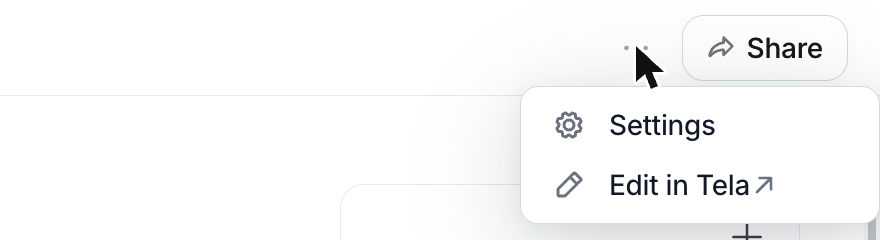
At the top bar, click on the three dots on the right of your app’s title and select “Connect via API”.
Get your app data
Here you will find all the necessary info to start creating tasks with our API. Choose your preferred language and use one of the snippets provided to get started!
By default, all tasks are created as if they were async completions. You’ll receive a success response and the task will have a running status. You have two options for consuming the result of the task:
Polling during execution
Passing a webhook URL
Polling tasks during execution
You can do a simple polling until the status of the task changes to either completed or failed. To poll the status of a task after creating it we can make a request to our API /task endpoint.
TypeScript Tela SDK
JavaScript Tela SDK
Python Tela SDK
let task = await tela . completions . create <{ document : TelaFile }, { fileSummary : string }>({
applicationId: process . env . TELA_APPLICATION_ID ,
variables: {
document: tela . createFile ( 'https://example.com/document.pdf' )
},
})
let isTaskCompleted = false
while ( ! isTaskCompleted ) {
const response = await fetch ( `https://api.tela.com/task/ ${ task . id } ` )
task = await response . json ()
isTaskCompleted = task . status === 'completed' || task . status === 'failed'
}
Passing a webhook URL
You can pass a webhook_url to your API call. This way you’ll receive a POST request in your endpoint when the task finishes.
Webhook Response Structure
When a task completes, your webhook endpoint will receive a POST request with the following structure:
{
"id" : "b83b1558-de5b-4e45-b517-7bececbdd154" ,
"status" : "succeeded" ,
"input_content" : {
"variables" : {
"document" : {
"file_url" : "https://example.com/document.pdf"
}
},
"messages" : []
},
"output_content" : {
"role" : "assistant" ,
"structured_content" : false ,
"content" : {
"fileSummary" : "This document contains quarterly financial reports showing a 15% revenue increase compared to last quarter, with key highlights in operational efficiency improvements and market expansion in the APAC region."
}
},
"raw_input" : {
"application_id" : "95cec438-6080-44fe-8275-28b16bd40178" ,
"variables" : {
"document" : {
"file_url" : "https://example.com/document.pdf"
}
},
"webhook_url" : "https://example.com/webhook"
},
"raw_output" : {
"fileSummary" : "This document contains quarterly financial reports showing a 15% revenue increase compared to last quarter, with key highlights in operational efficiency improvements and market expansion in the APAC region."
},
"compatibility_date" : "2024-10-14" ,
"prompt_version_id" : "76065caa-c519-441a-8fe2-cc43e29664ab" ,
"prompt_application_id" : "95cec438-6080-44fe-8275-28b16bd40178" ,
"workspace_id" : "3f55cfd9-4427-4887-a181-d9ad39967802" ,
"created_at" : "2024-10-14T19:00:53.664Z" ,
"updated_at" : "2024-10-14T19:01:15.892Z"
}
Key fields in the webhook response:
status: Can be “created”, “running”, “succeeded”, or “failed”
input_content: Contains the variables and messages sent in the request
output_content: Contains the structured output from your Canvas, matching your defined output schema
raw_output: The raw output data in the format defined by your Canvas outputs
Typescript Tela SDK
Javascript Tela SDK
Python Tela SDK
cURL
const task = await tela . completions . create <{ document : TelaFile }, { fileSummary : string }>({
applicationId: process . env . TELA_APPLICATION_ID ,
variables: {
document: tela . createFile ( 'https://example.com/document.pdf' )
},
webhook_url: "https://example.com/webhook"
})
Fetching tasks
To retrieve tasks from an app, you can send a GET request to the /task endpoint. This endpoint supports various optional parameters for filtering and pagination:
limit: Number of results per response (default: 10, range: 1-100)
offset: Starting position of results (default: 0)
Filtering parameters
status: Array of task statuses (options: “created”, “running”, “validating”, “completed”, “failed”)
since: Start date for filtering tasks (format: timestamp or ISO 8601)
until: End date for filtering tasks (format: timestamp or ISO 8601)
approvedBy: Email of the user who approved the task
revisionProcess: Type of revision received (options: “approvedWithRevisions”, “approvedDirectly”)
promptApplicationId: ID of the application where the task was created
promptVersionId: ID of the Canvas version used to create the task
ids: Array of specific task IDs to retrieve
Sorting parameters
orderBy: Field to sort by (options: “name”, “reference”, “approvedAt”, “createdAt”, “updatedAt”, “id”, “status”, “approvedBy”, “createdBy”)
order: Sort direction (options: “asc” or “desc”)
Example request
Here’s an example of fetching 50 completed tasks created after November 1st, 2024, sorted by name in ascending order:
const url = new URL ( 'https://api.tela.com/task' )
url . searchParams . append ( 'limit' , '50' )
url . searchParams . append ( 'promptApplicationId' , '{YOUR_APPLICATION_ID}' )
url . searchParams . append ( 'status' , JSON . stringify ([ 'completed' ]))
url . searchParams . append ( 'since' , '2024-11-01T00:00:00Z' )
url . searchParams . append ( 'orderBy' , 'name' )
url . searchParams . append ( 'order' , 'asc' )
const response = await fetch ( url , {
method: 'GET' ,
headers: {
'Authorization' : `Bearer ${ process . env . TELA_API_KEY } ` ,
'Content-Type' : 'application/json' ,
},
});
const tasks = await response . json ()